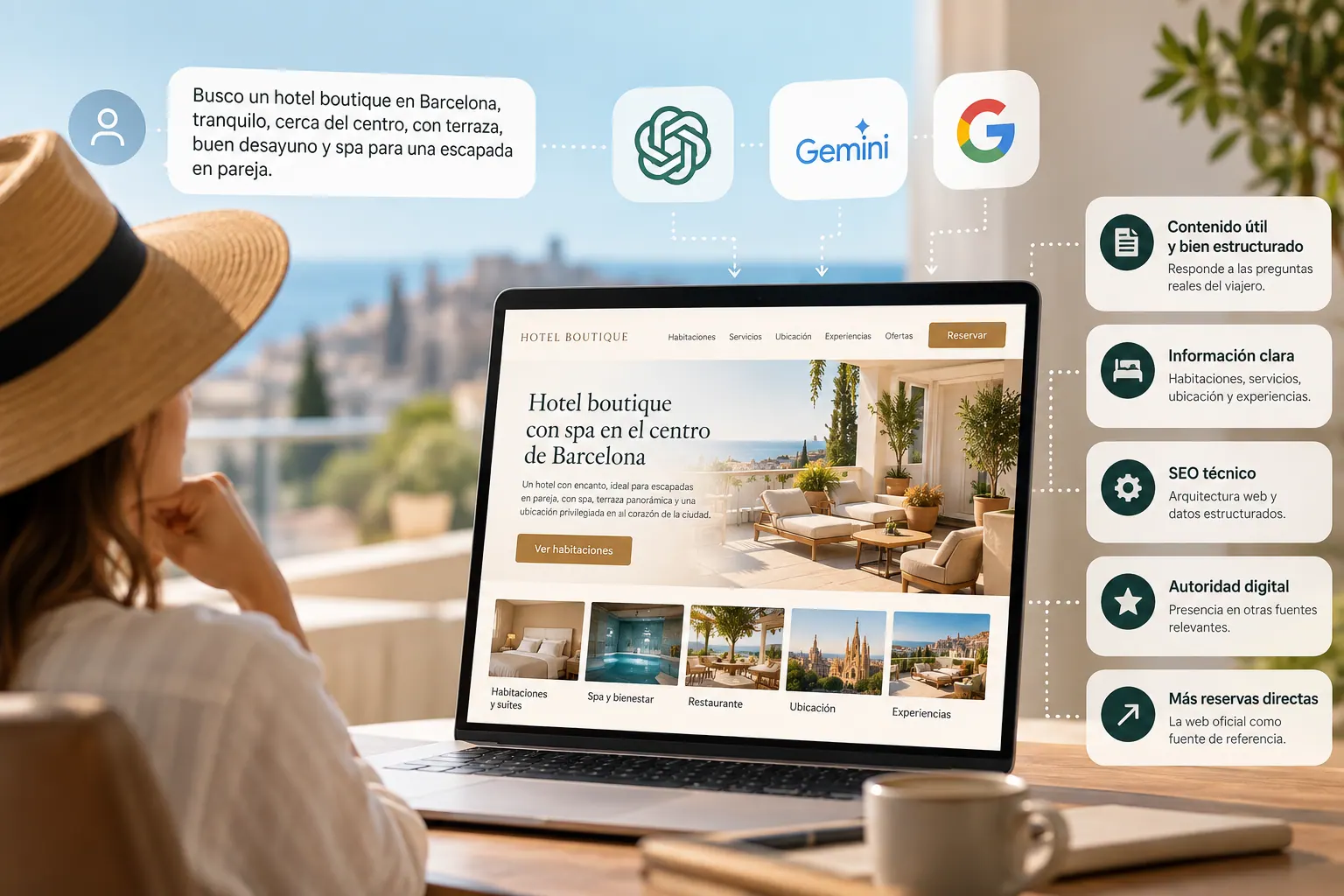
In the tourism sector, a hotel's website is more than a showcase: it is an indispensable tool for generating direct bookings. A well-designed site, optimised for search engines and with flawless performance, can make the difference between a guest who books with you and one who goes to the competition. In this guide, we explain how to improve your hotel's website to increase bookings, focusing on key aspects such as SEO, responsive design, loading speed and the effective use of headings.
SEO optimisation
Keyword research
The first step to improving your hotel's website is understanding what your potential guests are searching for. Use tools such as Google Keyword Planner or SemRush to identify relevant keywords, such as "family hotel in [your city]" or "hotel with spa in [your destination]". These keywords should be strategically integrated into your site's content, including titles, descriptions and body copy.
Meta tags and descriptions
Meta tags and descriptions are fundamental elements for SEO. Make sure every page on your site has a unique title tag and a meta description that includes relevant keywords and is appealing to users. This not only improves your organic ranking in search results, but also increases your click-through rate.
Heading hierarchy
A clear heading structure not only improves your site's readability, but also helps search engines understand the importance of each section. Use H1 headings for main titles, H2 for subheadings and so on. This organises your content logically and makes navigation easier.
Image optimisation
High-quality images are crucial in the hotel sector, as users want to see what the hotel is like and they do so through the images and videos on your website. That said, they can also slow your site down if they are not optimised properly. Compress your images and use alternative descriptions (alt text) with keywords to improve both loading speed and accessibility.
Responsive design
Adaptability to mobile devices
More and more users search and book from their smartphones. That is why it is essential that your hotel's website is fully responsive, meaning it adapts optimally to any screen size. Google also prioritises mobile-friendly sites in its rankings, so a responsive design is not just an improvement in the user experience, it is also an advantage in SEO terms.
Intuitive navigation
Responsive design must go hand in hand with simple navigation. Clear menus, visible call-to-action (CTA) buttons and booking forms that are easy to complete are key to a smooth experience on mobile. It is essential that your hotel's website is properly structured so that browsing is intuitive and straightforward for the user.
To improve a hotel's website, great importance must be given to CTAs, placing them in strategic locations and making them stand out with a colour, size or shape that differs from the rest of the text. The CTA copy must be clear and persuasive to encourage the user to click the button.
Valuable, up-to-date content
Quality blog
Keeping an active blog on your website not only improves SEO, but also attracts potential guests by offering valuable content. Write about local events, tourist activities or travel tips related to the hotel's location. This positions your hotel as a local expert and attracts organic traffic.
Booking engine
To increase your hotel's bookings, another very important element is having a good booking engine that matches the website in terms of design: the same colours, typography, rounded corners, etc.
The booking engine also has to be responsive, adapting to any type of screen, as well as guiding the user to complete the purchase in as few steps as possible.
Alojasuite is the intuitive booking engine that not only attracts, but also converts. It offers several modules to turn users into customers, retain them and build their loyalty so that they book again, and do so through your hotel's website.
share: