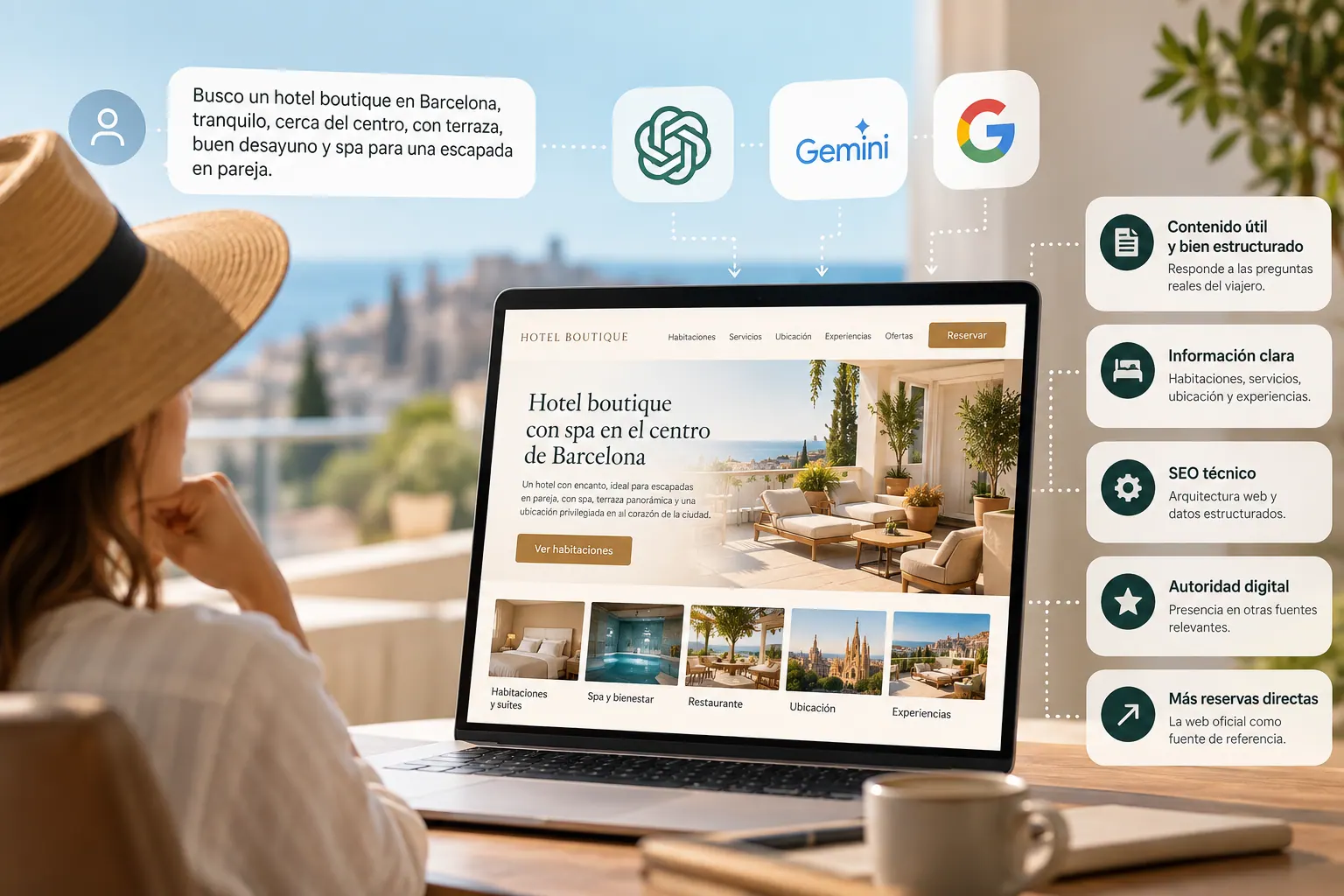
We are hearing more and more about GEO (Generative Engine Optimization) as the new discipline for getting a business to appear in the answers given by ChatGPT, Gemini and other artificial intelligence assistants.
And, as with any new technology, new acronyms, tools and supposed formulas for “ranking in AI” are appearing too.
But should hotels really forget about SEO and start doing GEO?
Not exactly.
Google has explained that there is no special optimisation for appearing in its AI-generated results. Many of the fundamentals are still familiar: relevant content, authority, good site architecture, clear information and a technically accessible website.
That does not mean, however, that we can ignore what is happening.
Because something is changing: how travellers search and how they discover a hotel.
From searching for keywords to explaining exactly what we need
For years, much of hotel SEO has been built around relatively simple searches:
“4-star hotel Barcelona”
“Hotel Madrid city centre”
These searches are not going to disappear.
But artificial intelligence allows far more natural and specific queries:
“I’m looking for a quiet hotel in Barcelona for a weekend away as a couple, close to the centre, with a terrace, a good breakfast and the option of a late check-out.”
We no longer have a single keyword. We have an intent, a context and several needs within the same search.
And this raises two important questions:
Do Google and AI assistants understand that our hotel can meet that need?
And, from a direct sales point of view:
Do they find that information on our official website, or do they need to turn to Booking, Expedia and other intermediaries to understand what we offer?
This is where SEO, content and GEO start to converge.
1. Work on intents, not just keywords
The first change is conceptual.
We should not think only about “hotel + destination”, but about why our guests travel, what they need and what questions they ask themselves before booking.
A couple may be looking for a romantic getaway. A family will want to know whether there are connecting rooms or activities for children. A business traveller may need parking, an early breakfast or good connections to the airport.
There are also searches related to pets, food, beaches, events, cycling, golf, wellness or local experiences.
All of this represents content opportunities.
It does not mean creating hundreds of artificial pages trying to answer every possible query. It means understanding our guests’ real intents and creating useful content around them.
2. Make your website the best source about your hotel
It seems obvious, but it does not always happen.
Try a simple test: compare how your own website describes your hotel with how an OTA describes it.
Where is it easier to find out about the rooms? Where are the services, opening hours, policies or location explained better?
Your property’s website should be the most complete, accurate and up-to-date source about our establishment.
Rooms, food and drink, services, location, experiences, policies, accessibility, transport, parking and the advantages of booking direct should all be clearly explained.
And whatever sets our hotel apart must also be written down and easy to understand.
It is not enough to show a photo of a spectacular terrace if we never explain anywhere that certain rooms have a private terrace with sea views.
Whatever we want travellers, search engines and AI assistants to understand must be clearly available on our website.
If an OTA explains our product better than we do, we are making it easy for third parties to become the main digital source about our hotel.
And that does not help our direct sales strategy.
3. Take care of the technical side: AI does not replace SEO
We can create excellent content, but search engines need to be able to find it, crawl it and interpret it.
That is why a logical site architecture, properly indexable pages, good internal linking, loading speed, mobile experience, well-implemented titles and headings, and structured data that helps correctly identify the hotel and its content are all still important.
Artificial intelligence does not make technical SEO obsolete.
Quite the opposite: if we want machines to understand our product better, we need to make their job easier.
4. Build authority beyond your own website
Google and AI assistants have no reason to rely solely on what we say about our own hotel.
Our brand’s presence on other relevant sources helps build context and authority.
Reviews, specialist media, tourism bodies, official destination websites, local publications, associations and third-party content can all help link our hotel to a location, a category or specific experiences.
If we want to be recognised as a hotel that is particularly appealing to cyclists, families, food lovers or couples on a romantic break, that association should exist outside our own website too.
That is why our visibility strategy does not end when we publish content.
So, SEO or GEO?
We are probably asking the wrong question.
It is not about abandoning everything we have learnt about SEO to chase the next fashionable acronym.
But nor is it about ignoring artificial intelligence because “it’s all still SEO”.
What matters is understanding that the search process is evolving.
Travellers will keep using Google, but they will also be able to ask ChatGPT, Gemini and other assistants to discover destinations, compare options and decide where to stay.
Our strategy must ensure that, wherever that search begins, our hotel can be found, understood and considered.
And, above all, that when travellers want more information, to check availability or to book, they find a clear path to our website.
We can call it SEO, GEO, AEO or invent a new acronym tomorrow.
Technology and channels will keep changing.
Our goal remains the same: gain more qualified visibility, increase bookings through the official website and reduce dependence on intermediaries.