Non-refundable rates and offers are, by far, the most repeated in hotel history.
They are simple, easy to understand and have no small print: if a guest gives up the option to cancel, they get a discount in return.
The traveller gets a lower price than the standard rate, and the hotel secures the booking no matter what.
All good, right? 👌
On paper, yes; when making the booking, the guest assumes that nothing and nobody will stop them enjoying their stay. And hey, a discount is a discount.
But… what if something happens?
Drama? An angry guest? A negative review on social media? 😱
None of that: virtual wallets are the solution.
The non-refundable rate: yes, but…
We take it for granted that every guest knows the score.
Nobody gives you something for nothing, as the saying goes.
If a guest books with that rate they get a discount —5%, 10%, 15%… depending on the hotel—, but they completely waive the right to ask for a refund if in the end they cannot come.
The problem is that many people, when something happens to them, look for a mix of empathy and compassion that will get their money back.
They do not see that the hotel has given up selling that room to someone else at a higher price.
They do not see that the hotel is lowering its RevPAR in exchange for a certain "security".
They do not see what the hotel is giving up; they only see that their car has decided not to start and that it is not their fault.
They see that the hotel should empathise with them and give them their money back, however "non-refundable" the rate may be.
And that means… well, all sorts of things, and all of them bad:
- Customer service time spent explaining that the money cannot be refunded
- Total dissatisfaction on the part of the customer, who believes they have the right to claim, even though they do not
- The hotel generates the revenue, yes, but the profit shrinks because of all the time invested in the customer, and some of them can put up quite a fight
Not all customers are like that, mind you. Some know what they are giving up when they book the non-refundable rate, and if something happens, it happens, but it is not the hotel's fault.
Either way, both for those who claim and for those who do not, virtual wallets are a fantastic remedy.
A perfect solution to remove the booking objection of "What if something happens and I can't go?".
Add a virtual wallet to your booking system and watch out...
A virtual wallet is nothing more than a personal balance for each customer, to avoid refund requests.
The balance is not real money, but virtual; that is, the customer cannot withdraw the money, only spend it.
The idea is that when the hotel sells the non-refundable rate, it pairs it with a credit to the virtual wallet, like this:
"And if you can't come for whatever reason, don't worry, you won't lose it: we'll keep it for you in a virtual wallet and you can come whenever you like".
Well, this, which seems like such a small thing, besides removing that sales objection we were talking about, leads you to this:
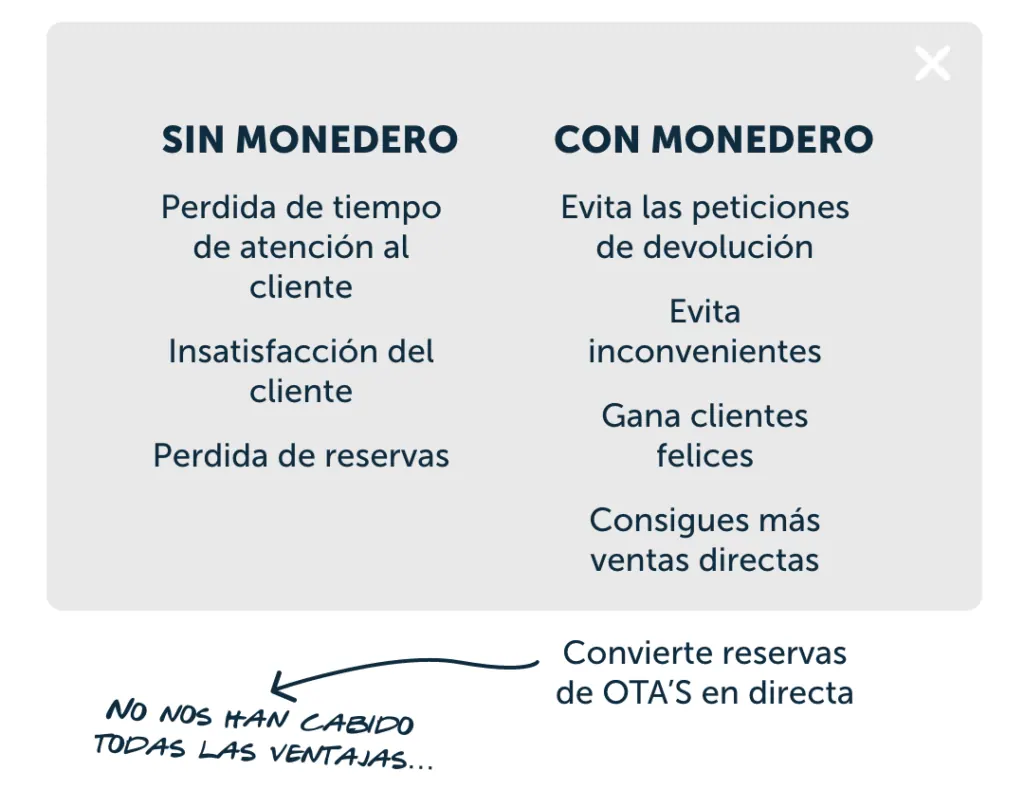
You build loyalty with more customers
Let's say that, unfortunately, something happens to a customer and they never make it to the hotel.
Without a virtual wallet they have two options:
- They lose the money, accept it and that's that
- They lose the money, get angry and become a problem the hotel staff have to deal with
With the wallet, they simply postpone their stay.
Sometimes this will be of no use to them; if they are on a long trip and will not be returning to that country, what do they want a voucher worth a certain amount of money for?
Unless we are talking about a chain with hotels in many locations, of course 😅
But in many other cases the wallet ensures that the customer chooses the hotel —or another in the chain— and does not go to the competition when they can finally make the trip.
And if the guest does come to the hotel, the chances of building their loyalty grow, so that they return later on or stay at another property in the chain on another trip.
If you apply this way of working on hotel loyalty… that's the icing on the cake 🤙
You get more direct bookings
The wallet balance must necessarily be spent at the hotel or hotel chain.
There is no other option.
No Booking, no Expedia, no OTA that suddenly cheats, breaks parity and cuts prices more than it should.
The wallet secures the direct sale and, with the stay, you get yet another opportunity to build the customer's loyalty.
A chance for direct bookings to keep coming time and time again, taking advantage of whatever perks the direct channel offers.
Honestly… how can you say no to adopting the wallet, eh?
And it's not just easy, it's incredibly easy to implement if you know where to go
The technology behind a wallet that avoids refunds is somewhat complicated if you don't know where to turn.
If you develop it independently, automatic integration with your booking system will be impossible and you will have to do everything by hand.
A nightmare.
If, on the other hand, the wallet belongs to the same solution you have adopted as the hotel's booking system, you won't have to manage anything.
Everything will be done automatically.
Your hotel, happy with its guest and with not having to spend time on either an impossible refund or a customer complaint.
And the guest, happy that the hotel empathises with situations like theirs and that their money is not lost, but can be used later on.
Needless to say, it is essential that the wallets work in as many countries and currencies as the booking engine does, otherwise… 😓
Well, at Alojapro we are crystal clear on this, and the wallet is one of the features our clients value most.
If you want to see it for yourself, whether you have a small hotel, a large one or a chain, we can show you everything in a short, free demo.
share: